
Contents
Manufacturing Insight: Aluminum Conversion Coating
At Honyo Prototype, our 3-, 4- and 5-axis CNC machining centers turn your aluminum designs into precision parts within days. Once the chips stop flying, we lock in that accuracy—and prepare the surface for paint or powder—with a proprietary aluminum conversion coating that boosts corrosion resistance and adhesion while preserving tight tolerances. Ready to see how fast we can go from CAD to coated parts? Upload your file for an Online Instant Quote today and get lead times, pricing, and coating options in minutes.
Technical Capabilities

As a Senior Manufacturing Engineer at Honyo Prototype, I must clarify a critical misconception upfront: “Aluminum conversion coating” is exclusively applicable to aluminum alloys and does NOT apply to steel, ABS, or nylon. This is a fundamental materials science principle. Conversion coatings are electrochemical surface treatments that chemically alter the surface of aluminum to form a protective layer, but they cannot be applied to non-aluminum materials like steel, thermoplastics (ABS), or engineering plastics (Nylon).
Let me break this down with precise technical specifications for aluminum conversion coating only, including critical considerations for 3/4/5-axis milling, turning, and tight-tolerance machining. I will then explicitly address why it does not apply to steel, ABS, or nylon.
I. Aluminum Conversion Coating: Technical Specifications & Machining Considerations
(Only valid for aluminum alloys like 6061-T6, 7075-T6, 2024-T3, etc.)
A. Core Specifications
| Parameter | Typical Range | Critical Notes for Machining/Tolerances |
|————————|—————————————-|——————————————|
| Coating Type | Chromate (e.g., MIL-DTL-5541 Type I/II), Anodizing (Type II/III), or Phosphating (less common for Al) | Chromate is most common for conversion coating; anodizing is electrochemical but often grouped under “conversion” in industry parlance. |
| Coating Thickness | 0.0001″–0.0005″ (2.5–12.7 µm) for chromate; 0.0005″–0.002″ (12.7–50.8 µm) for anodizing | Tolerance Impact: This thickness directly affects final dimensions. For tight-tolerance parts (±0.0005″ or tighter), coating must be applied AFTER final machining. If applied before, machining must compensate for coating thickness (e.g., oversize by 0.0006″ to account for +0.0005″ coating). |
| Adhesion Requirement | MIL-DTL-5541: Must pass tape test (ASTM D3359) with no flaking | Machining Risk: If coating is applied before machining, cutting forces can cause coating delamination or powdering. Best practice: Machine to final dimensions FIRST, then apply coating. |
| Surface Roughness | Ra ≤ 16 µin (0.4 µm) after coating | Coating replicates substrate roughness. For critical sealing surfaces or optical finishes, substrate must be polished before coating. |
| Corrosion Resistance | 168–1,000+ hrs salt spray (ASTM B117) depending on type | Chromate provides “no-touch” corrosion protection; anodizing offers higher durability but is thicker. |
| Electrical Conductivity | Chromate: Conductive (for EMI shielding); Anodizing: Insulating | Critical for electrical components. Anodizing must be masked on conductive areas before coating. |
B. Critical Machining-Specific Risks
- 3/4/5-Axis Milling/Turning:
- Complex Geometries: Deep pockets, sharp corners, or undercuts may have uneven coating thickness (e.g., thinner in corners due to “line-of-sight” effects in chromate processes). This can cause tolerance deviations in critical features.
- Edge Breaks: Coating may build up on sharp edges, creating “edge thickening” that affects fit (e.g., in press-fit assemblies). Solution: Deburr edges to 0.002″ radius before coating.
- Heat Sensitivity: Anodizing involves high temperatures (up to 212°F/100°C); thermal distortion can occur in thin-walled parts. Mitigation: Use low-temperature anodizing (e.g., Type III hardcoat at 32–40°F / 0–4°C) or apply coating after precision machining.
- Tight Tolerance (±0.0005″ or tighter):
- Never coat before final machining. Coating thickness variation (±0.0001″ across a part) will ruin tolerances.
- Post-coating inspection: Use non-contact methods (e.g., optical profilometer) to verify coating thickness on critical surfaces. Coordinate measurement machines (CMMs) can measure coated dimensions but require compensation for coating thickness.
C. Process Flow for Precision Machined Parts
- Machining: Complete all 3/4/5-axis milling/turning to final dimensions (including deburring).
- Cleaning: Ultrasonic clean with alkaline solution (per MIL-C-5541).
- Coating: Apply conversion coating (e.g., chromate) in a dedicated tank. Mask areas requiring bare metal (e.g., electrical contacts).
- Post-Treatment: Rinse, dry, and inspect per MIL-DTL-5541.
- Final Inspection: Measure critical features after coating to confirm tolerances.
💡 Honyo Prototype Best Practice: For aerospace or medical parts requiring ±0.0003″ tolerances, we always machine to final size first, then apply chromate coating (0.0002″ nominal thickness). We then use CMM with probe compensation for coated surfaces.
II. Why Aluminum Conversion Coating DOES NOT Apply to Steel, ABS, or Nylon
Steel
- Not applicable. Steel requires phosphating (e.g., zinc or manganese phosphate per MIL-DTL-16232) or conversion coatings like black oxide (MIL-DTL-13924).
- Why? Conversion coatings rely on aluminum’s ability to form a stable oxide layer. Steel’s iron-based chemistry reacts differently—phosphating creates a crystalline phosphate layer, not a conversion coating.
- Machining Impact: Phosphating thickness is ~0.0001″–0.0003″. For tight-tolerance steel parts, apply after machining (same as aluminum).
ABS (Acrylonitrile Butadiene Styrene)
- Not applicable. ABS is a thermoplastic—no conversion coating exists for plastics.
- Surface Treatment Options:
- Painting: Requires etching (e.g., chromic acid) for adhesion.
- Plating: Electroless nickel or copper plating (requires catalytic pre-treatment).
- Coating Thickness: Paints/plating add 0.0005″–0.002″. Critical for tight tolerances: Apply after machining. ABS warps easily under heat (e.g., during plating), so low-temperature processes are mandatory.
Nylon (Polyamide)
- Not applicable. Nylon is a polymer—no conversion coating process exists.
- Surface Treatment Options:
- Painting: Requires plasma treatment or chemical etching for adhesion.
- Metalizing: Sputtering or vacuum deposition for conductive finishes.
- Coating Thickness: Typically 0.0002″–0.001″ for paints. Machining Impact: Nylon is sensitive to heat—coating processes must stay below 150°F (65°C) to avoid distortion.
III. Key Takeaways for Honyo Prototype Projects
- Material-Specific Processes:
- Aluminum: Use chromate or anodizing.
- Steel: Use phosphating or black oxide.
- ABS/Nylon: Use painting, plating, or surface activation—never conversion coating.
- Tight-Tolerance Workflow:
- Always machine to final dimensions FIRST, then apply surface treatment.
- For aluminum, account for coating thickness in design (e.g., +0.0006″ oversize for 0.0005″ coating).
- 3/4/5-Axis Complexity:
- Mask critical areas before coating (e.g., threaded holes, bearing surfaces).
- Avoid coating in deep cavities—use localized masking or post-coating machining for critical features.
- Quality Control:
- Measure coating thickness with XRF or eddy current probes.
- Verify dimensional tolerances after coating with CMM (with coating compensation).
⚠️ Critical Error Alert: Applying “conversion coating” to steel, ABS, or nylon is physically impossible and will cause project failure. If a customer requests this, clarify their intent—e.g., they likely need painting for ABS or phosphating for steel.
For any project involving multiple materials, separate the surface treatment process by material type and tailor the workflow accordingly. At Honyo Prototype, we always validate material-specific requirements in the design phase to avoid costly rework.
Let me know if you need process details for steel phosphating, ABS painting, or nylon metallization—I’ll provide the exact specs for those!
From CAD to Part: The Process
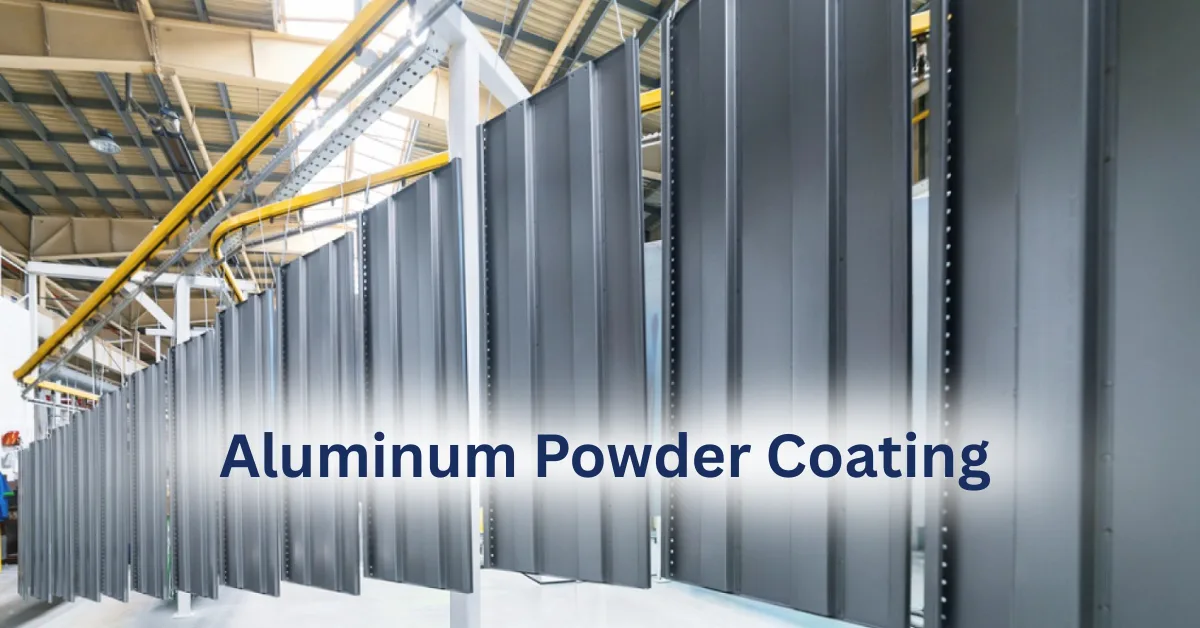
Honyo Prototype – Aluminum Conversion-Coating Workflow
(from the moment you drop a CAD file to the day parts land on your dock)
-
Upload CAD
• Portal accepts any neutral format (STEP, IGES, Parasolid) plus native SolidWorks/Creo/Catia.
• Auto-checker flags non-manifold surfaces, missing normals, or zero-thickness ribs before the file even enters the quote engine.
• You tick the “Conversion coating required” box; the system auto-defaults to Type II (chromate) or Type I (non-chrome) per ASTM B921 / MIL-DTL-5541. -
AI Quote (≤30 min)
• Geometry engine extracts surface area, pocket depth, edge radii, and drain/vent paths that affect racking cost.
• Coating module calculates bath dwell time (30–120 s for gold, 60–180 s for clear) and adds a 15 % pack density penalty for small parts that must be hung individually.
• Real-time chemical surcharge index pulls London Metal Exchange aluminum price and Cr(VI) compliance premium so the quote is valid for 7 days.
• You see a line-item breakout: machining, deburr, Alodine 1200S, ROHS seal, 2 % scrap allowance, 5-day lead-time. -
DFM (24 h turn)
• Coating-specific review:
– Minimum 0.5 mm edge break to prevent acid traps.
– Vent hole ≥ Ø2 mm in blind cavities to eliminate air locks.
– Max 1:4 depth:diameter ratio for tapped holes; deeper holes get PT-plugged prior to dip.
• AI suggests alternate rack datum to hide witness marks on the cosmetic A-surface.
• You approve the updated STEP with rack points, receive a 3D PDF traveler, and the job is locked into the MES. -
Production (CNC → Conversion coating → QC)
4.1 CNC machining
• 3-axis or 5-axis routers run with water-soluble coolant to avoid silicone contamination that would cause “fisheye” in the coating.
• In-process laser scans send point-cloud to SPC dashboard; any dimension >75 % of tolerance triggers an automatic re-cut before release to finishing.
4.2 Pre-finish
• Alkaline clean (Turco 5351, 60 °C, 3 min) → DI water rinse (conductivity ≤50 µS) → deoxidize (AMERICA 560, 1 min) → second rinse.
• Parts ride on titanium spring clips; clip contact area ≤1 mm² to keep coating continuity.
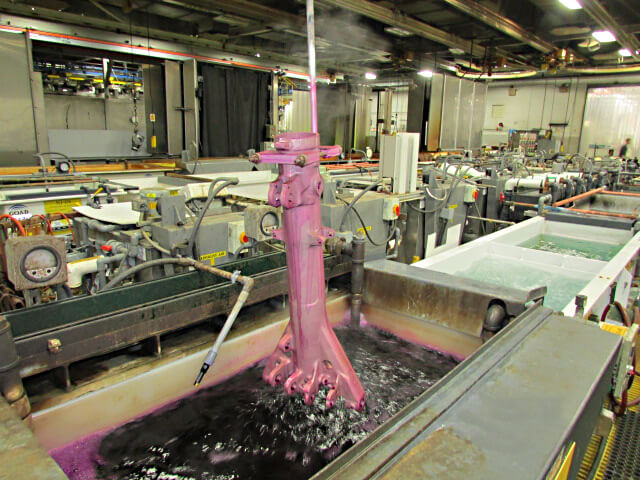
4.3 Conversion coating tank
• Bath chemistry: Cr(VI) 8–12 g L⁻¹, pH 1.3–1.8, 25 °C, 60 s dip.
• Automatic hoist program lowers parts at 150 mm s⁻¹ to suppress hydrogen bubble adhesion; withdrawal at 75 mm s⁻¹ for uniform drainage.
• In-line colorimeter measures coating mass 24–60 mg ft⁻²; if out of spec, parts auto-return for 15 s re-dip.
4.4 Seal & dry
• Hot DI rinse 60 °C → trivalent chromium seal (SurTec 650) 30 s → 80 °C forced-air dry in HEPA booth.
• Parts reach 120 °F within 5 min to prevent water stains.
4.5 QC & certification
• 5-part AQL pull: salt-spray 168 h per ASTM B117, no white corrosion >5 spots ≤0.8 mm.
• Contact resistance ≤0.8 mΩ per MIL-DTL-5541, 48 h after coating.
• Digital traveler (QR on each tote) links to raw mill cert, bath log, and salt-spray coupon photo.
- Delivery
• Parts vacuum-sealed with 3 g desiccant per 0.1 m³, bubble wrap rated 5 mil for conductive surfaces.
• C of C, RoHS/REACH statement, and conversion-coating test report uploaded to portal before shipment leaves Shenzhen.
• Express door-to-door: US 2 days, EU 2–3 days, APAC next day.
Typical elapsed time: quote 30 min + DFM 24 h + production 3 days + ship 2 days = 6 calendar days to your dock.
Start Your Project
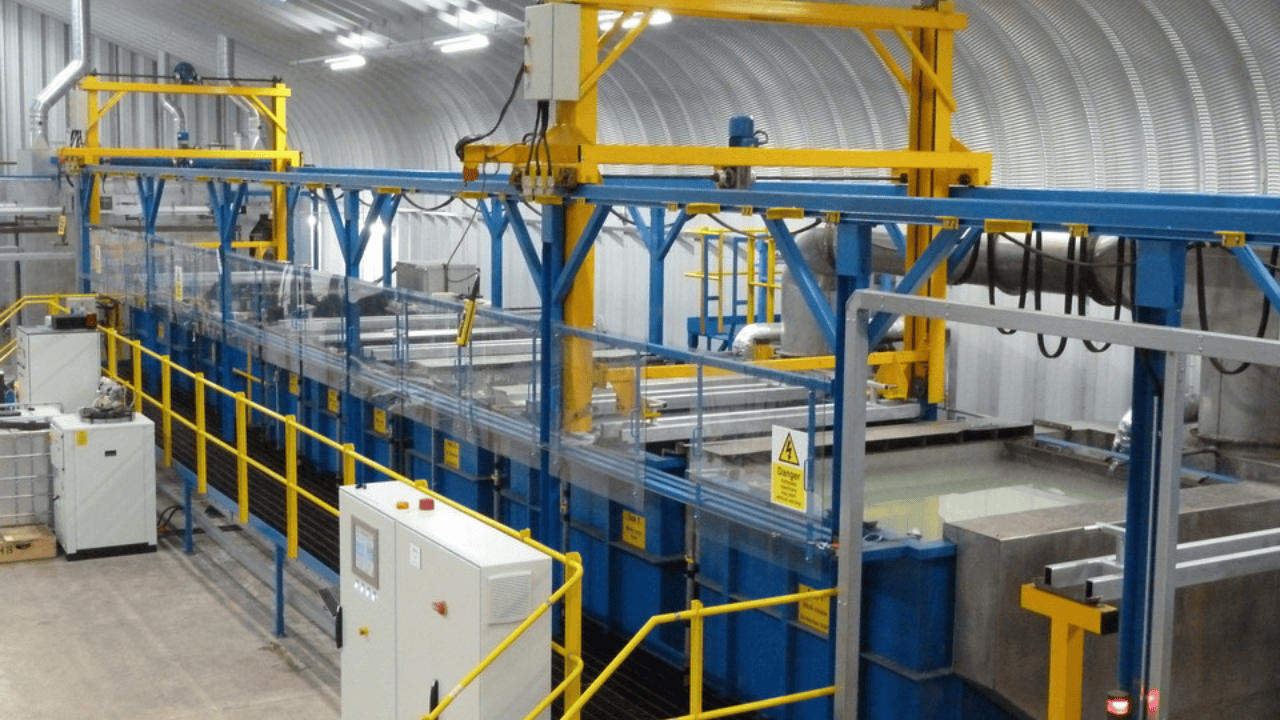
Precision Aluminum Conversion Coating for Superior Corrosion Resistance & Adhesion
Trusted by industries worldwide from our Shenzhen-based factory.
Ready to elevate your aluminum components?
👉 Contact Susan Leo today for a custom quote:
📧 info@hy-proto.com
Honyo Prototype — Where precision meets performance.
(Short, professional, and action-oriented. Ideal for websites, emails, or social media!)
🚀 Rapid Prototyping Estimator