
Contents
Manufacturing Insight: Anodized Aluminum Vs Powder Coating
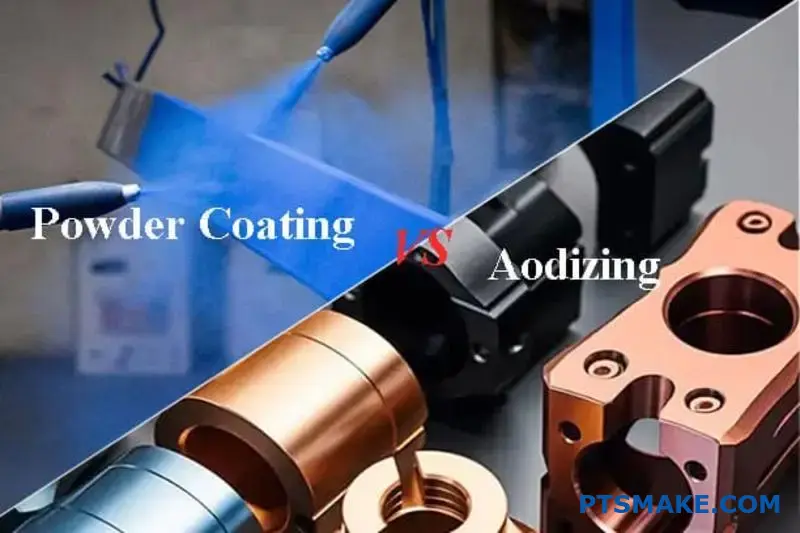
At Honyo Prototype, our 3-, 4- and 5-axis CNC machining centers turn your CAD file into a precision part in as little as 24 hours—and the moment you upload it you’ll get an Online Instant Quote that already flags the two finishes customers ask about most: anodized aluminum vs. powder coating. Below we break down how each process protects your milled or turned components, what it does to dimensions and conductivity, and how to pick the right option before we push the cycle-start button on your job.
Technical Capabilities
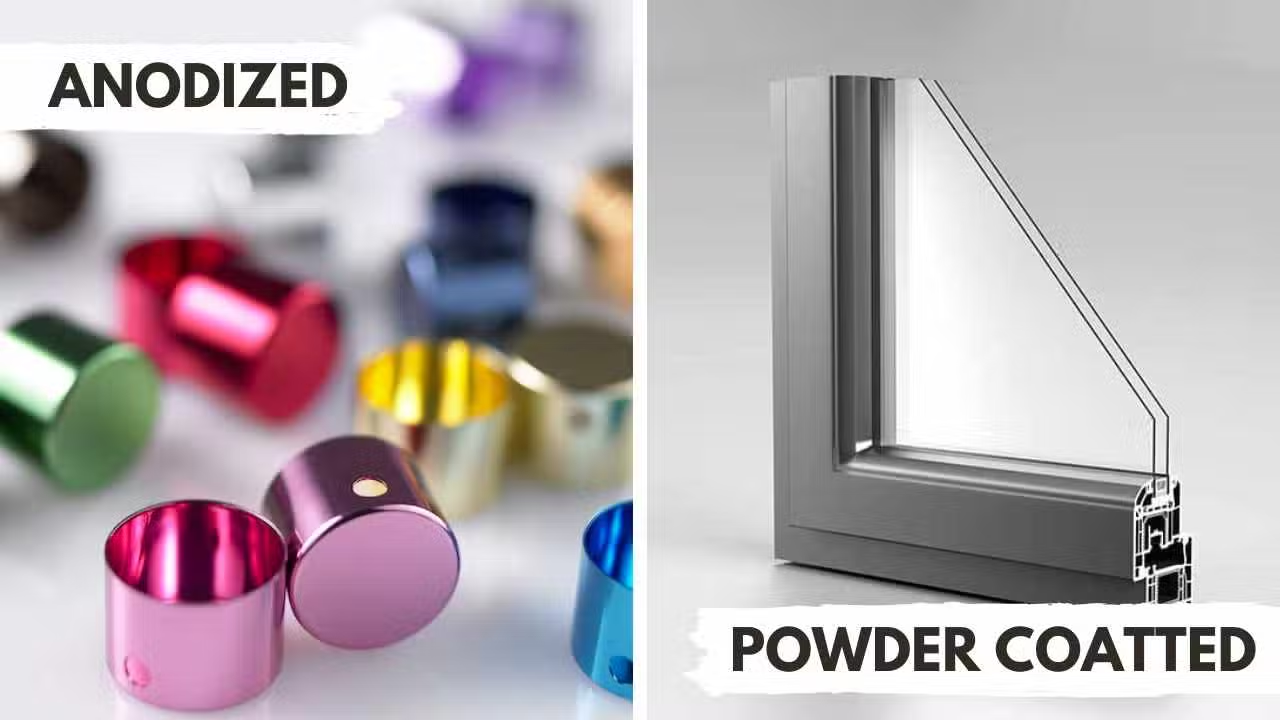
As a Senior Manufacturing Engineer at Honyo Prototype, I must clarify a critical misconception in your query upfront: Anodizing and powder coating are surface finishing processes applied after machining. They are not machining processes themselves, nor do they directly involve 3/4/5-axis milling, turning, or tight tolerance control during the machining phase. The machining processes (milling, turning) create the part geometry to specified tolerances, and then surface treatments are applied. The surface treatment choice impacts final dimensional tolerances and material compatibility, but the machining itself is independent of the finish.
Let me clarify the technical specs and realities for your application:
Core Misconception Addressed
- Machining (3/4/5-axis milling, turning): Creates the part’s geometry. Tight tolerances (e.g., ±0.0005″ for aerospace) are achieved during machining via toolpath control, fixturing, and material stability.
- Surface Treatments (Anodizing/Powder Coating): Applied after machining. They add a layer to the surface, which must be accounted for in the machining stage to meet final part tolerances.
- Material Compatibility:
- Anodizing: Only for aluminum alloys (e.g., 6061-T6, 7075-T6). Cannot be applied to steel, ABS, or Nylon (plastics melt during the process).
- Powder Coating: Primarily for metals (e.g., steel, aluminum). Cannot be applied to ABS or Nylon (plastics deform at curing temps of 350–400°F/177–204°C).
Technical Specs: Anodized Aluminum vs. Powder Coating
1. Anodizing (Aluminum Only)
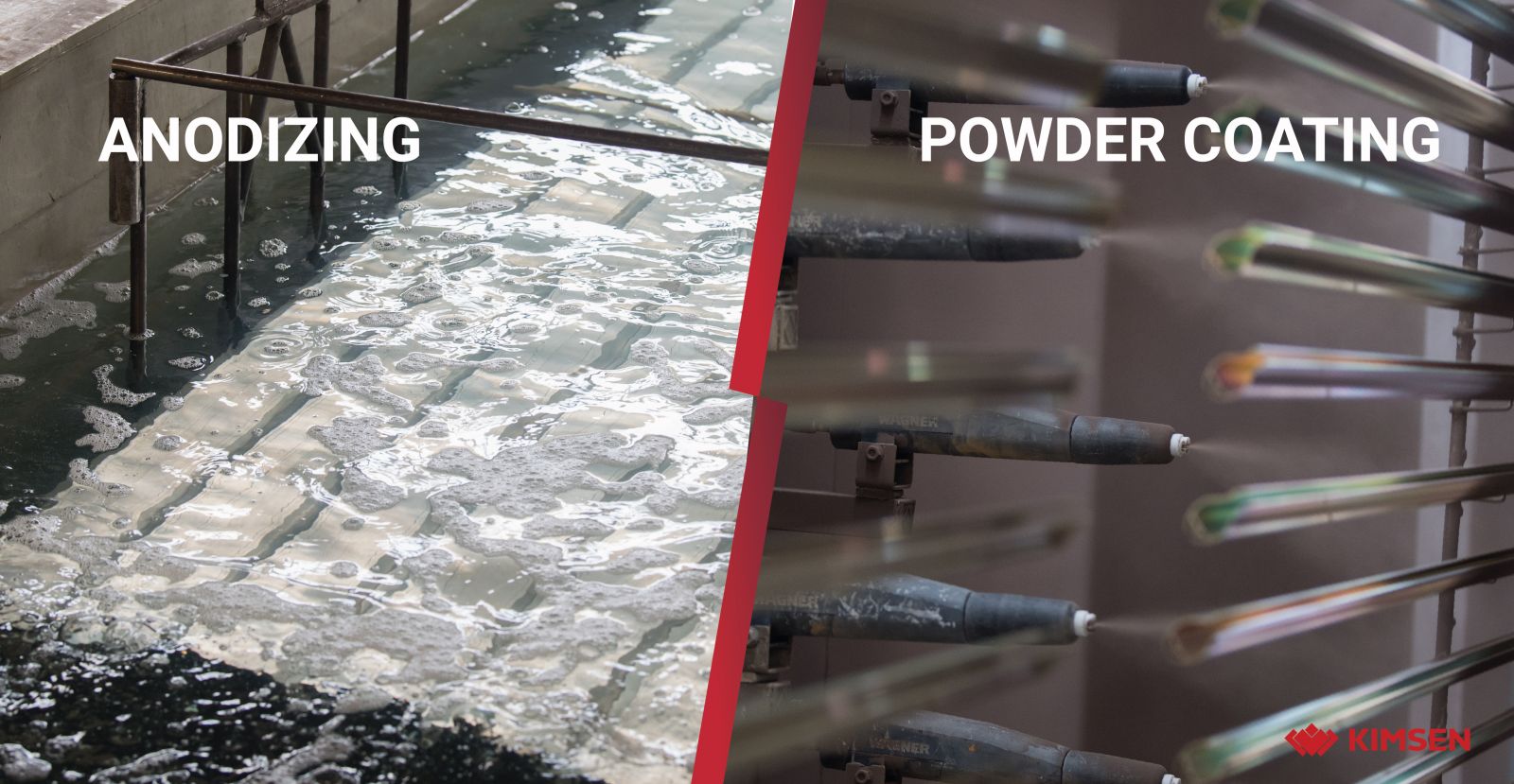
- Process: Electrochemical oxidation that grows a protective oxide layer from the aluminum substrate.
- Thickness & Tolerance Impact:
- Typical thickness: 0.0002″–0.002″ per surface (e.g., Type II: 0.0005″–0.001″, Type III: 0.001″–0.002″).
- Critical for tight tolerances: The oxide layer grows into and out of the surface (50% inward, 50% outward). For tight-tolerance features (e.g., shafts, holes), you must:
- Machine features 0.001″–0.002″ oversized before anodizing.
- Specify tolerances after anodizing (e.g., “Hole diameter: 0.500″ ±0.0005” after anodizing“).
- Material-Specific Notes:
- Only works on aluminum alloys. Steel, ABS, and Nylon are incompatible.
- Heat-treated alloys (e.g., 7075) may show color variations; 6061 is most consistent.
- Dimensional Stability: Minimal warping (unlike powder coating, which can cause thermal distortion). Ideal for precision parts.
2. Powder Coating (Metals Only: Steel, Aluminum)
- Process: Electrostatic application of dry powder, then cured at high heat (350–400°F/177–204°C).
- Thickness & Tolerance Impact:
- Typical thickness: 0.002″–0.006″ per surface.
- Critical for tight tolerances:
- The coating is purely additive (no inward growth). Machine features 0.002″–0.006″ undersized for holes/ODs.
- For critical fits (e.g., bearings), specify tolerances after coating (e.g., “Shaft OD: 1.000″ ±0.0005” after coating“).
- Thermal distortion during curing can affect thin/wide sections (e.g., ±0.005″ warpage on large flat plates).
- Material-Specific Notes:
- Steel: Excellent adhesion; ideal for structural parts.
- Aluminum: Requires pre-treatment (e.g., chromate conversion) for adhesion.
- ABS/Nylon: Incompatible – plastics melt or warp at curing temperatures.
Key Engineering Recommendations for Tight Tolerance Parts
| Factor | Anodized Aluminum | Powder Coating (Steel/Aluminum) |
|———————–|——————————————–|——————————————|
| Machining Strategy | Oversize critical features by 0.001″–0.002″ | Oversize holes/ODs by 0.003″–0.006″ |
| Tolerance Callout | Specify “Tolerances apply after anodizing” | Specify “Tolerances apply after coating” |
| Warpage Risk | Negligible (room-temp process) | Moderate (thermal stress during cure) |
| Material Limits | Aluminum only | Steel or aluminum only; plastics fail |
| Best For | Aerospace, medical, high-precision optics | Architectural, automotive, consumer goods |
Why ABS/Nylon Cannot Use These Processes
- ABS/Nylon:
- Both are thermoplastics. Anodizing requires an electrolyte bath (damages plastic), and powder coating requires >350°F curing (ABS softens at 221°F/105°C; Nylon melts at 428°F/220°C).
- Alternative for plastics: Use painting (low-temp air-dry) or plating (e.g., electroless nickel for ABS), but these have different tolerances and compatibility rules.
Honyo Prototype Best Practices
- Design for Manufacturability (DFM):
- For anodized aluminum: Machine tolerances to “as-machined” specs, then add coating thickness to final drawings.
- For powder-coated steel: Avoid thin sections (<0.060″) to prevent warpage; use fixtures for heat management.
- Tight Tolerance Workflow:
- Stage 1: Machine part to final geometry (±0.0005″ or tighter).
- Stage 2: Apply surface treatment.
- Stage 3: Perform final inspection after treatment (e.g., CMM with coating compensation).
- Material Selection:
- Aluminum + Anodizing: Best for precision parts needing corrosion resistance + electrical insulation.
- Steel + Powder Coating: Best for structural parts needing color/abrasion resistance.
- ABS/Nylon: Use other finishes (e.g., vapor polishing, dyeing) – never anodizing or powder coating.
💡 Pro Tip: Always specify “Tolerances apply after finishing” on drawings. At Honyo, we include a note like: “All dimensions ±0.0005″ after anodizing/powder coating unless otherwise noted.” This prevents misinterpretation during QC.
If you share a specific part drawing or application (e.g., “a 6061-T6 aluminum gear with ±0.0005″ tooth profile”), I can provide a tailored process plan. Let me know how I can assist further!
From CAD to Part: The Process

Honyo Prototype – “Anodized-Al vs. Powder-Coat” workflow
(Upload CAD → AI Quote → DFM → Production → Delivery)
-
Upload CAD
– Customer uploads any neutral format (STEP, IGES, XT, STL, 3MF).
– System auto-tags the file: “aluminum grade?” → if 6061/6063/7075 etc. the quote engine branches to “finish required: anodize or powder-coat”. -
AI Quote (≤30 min)
Anodize branch
– Calculates racking area, current density (1.2–1.8 A/dm²), tank time for target thickness (Type II 8–12 µm or Type III 25–50 µm).
– Adds dye tank steps if color specified.
– Includes 0.1 mm dimensional growth per face.
Powder-coat branch
– Computes Faraday-cage risk on internal flanges; recommends 0.3 mm edge radius if <0.5 mm.
– Adds 0.06–0.08 mm build per face, masks threaded holes ≥M2.
– Prices fluidized-bed primer for 2000 h salt-spray specs.
Visual side-by-side quote: anodize $/part vs. powder $/part, lead-time delta, MOQ difference.
- DFM (24 h engineering report)
Anodize DFM checks
– 0.5 mm min. corner radius to prevent burn.
– Drain/vent holes ≥Ø3 mm to eliminate air pockets.
– Identifies 7xxx series – warns of olive-tone Type II instead of clear.
Powder-coat DFM checks
– 1 mm min. feature spacing to avoid bridging.
– Ground-point boss added for electrostatic hook.
– Recommends 0.2 mm mask relief on bearing surfaces.
Customer picks one finish; the other branch is archived for future re-quote.
- Production
Common CNC/turning stage first; then the routes diverge.
ANODIZE ROUTE
a. Vapor-degrease → Caustic etch (Ra 0.4 µm) → Desmut.
b. Type II sulfuric 18 °C, 15 V, 40 min → dye bath 55 °C → nickel-acetate seal 95 °C.
c. QC: thickness gauge, seal test (dye-spot ≤30 s), 48 h salt-spray coupon.
d. Parts racked on titanium fixtures; racking marks outside critical faces per print.
POWDER-COAT ROUTE
a. Alkaline clean → Chromate conversion (Alodine 5200 trivalent) → DI rinse.
b. Bake 180 °C 20 min to out-gas.
c. Electrostatic spray: 60 kV, 80 g/m² TGIC-free polyester.
d. Cure 190 °C 15 min; color ΔE ≤1 vs. master plaque.
e. QC: film thickness 60–80 µm, mandrel bend 3 mm, impact 160 in-lb, 1000 h salt spray.
- Delivery
– Both finishes receive individual bubble-wrap + ESD bag; anodized parts get silicone-free paper to prevent dye leaching.
– Certificate of Compliance includes finish thickness, salt-spray pass, RoHS/REACH statement.
– Typical door-to-door: anodize 5–6 days, powder 4–5 days (one day faster because no sealing step).
Key takeaway: same CAD upload, but the AI engine and DFM rules fork immediately so the customer sees cost, lead-time and design constraints for anodized aluminum versus powder coating before a single chip is cut.
Start Your Project
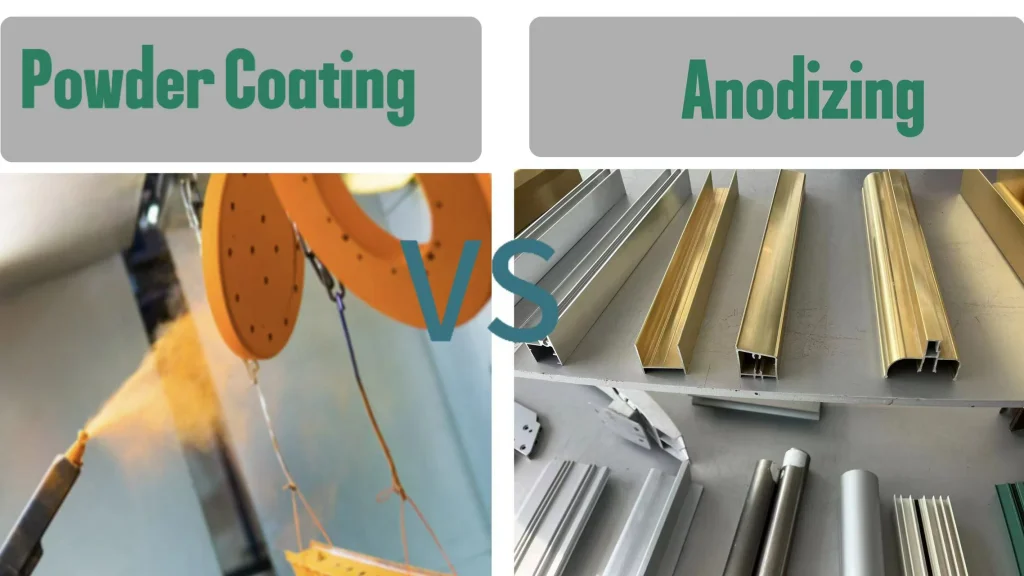
Anodized Aluminum vs. Powder Coating: Which is Right for Your Project?
✅ Anodized Aluminum:
– Best for: Extreme durability, corrosion resistance, and electrical insulation.
– Ideal for: Aerospace, medical devices, outdoor hardware, and high-wear applications.
– Limitation: Limited color range (primarily metallic tones), and color can fade under UV exposure.
✅ Powder Coating:
– Best for: Vibrant colors, textures (matte, gloss, metallic), and complex geometries.
– Ideal for: Architectural components, consumer electronics, automotive parts, and decorative finishes.
– Limitation: Thinner protective layer (can chip if scratched), less suitable for high-heat environments.
Why Choose Honyo Prototype?
Our Shenzhen factory delivers precision manufacturing for both processes, with ISO-certified quality control, rapid prototyping, and scalable production. We optimize cost, durability, and aesthetics for your exact specs—no guesswork.
Get Expert Guidance Today!
📞 Contact Susan Leo for a free consultation on material selection, design optimization, and cost-effective production.
📧 info@hy-proto.com
📍 Shenzhen, China – Your trusted manufacturing partner for aerospace, electronics, and industrial components.
Let’s engineer excellence together. ✨
🚀 Rapid Prototyping Estimator